King Paimon—a spirit of grandeur, knowledge, and unerring authority in the realms beyond! When one speaks of King Paimon, we do not speak lightly; for he is not merely a figure conjured by those curious for a glimpse into the hidden, but a force of profound resonance, revered by ceremonial magicians and feared by those who lack the strength to wield his presence wisely. Let me lead you through a journey into his domain, his history, his strengths, and, most importantly, the practices and protocols for those daring enough to call upon him.
Prologue:
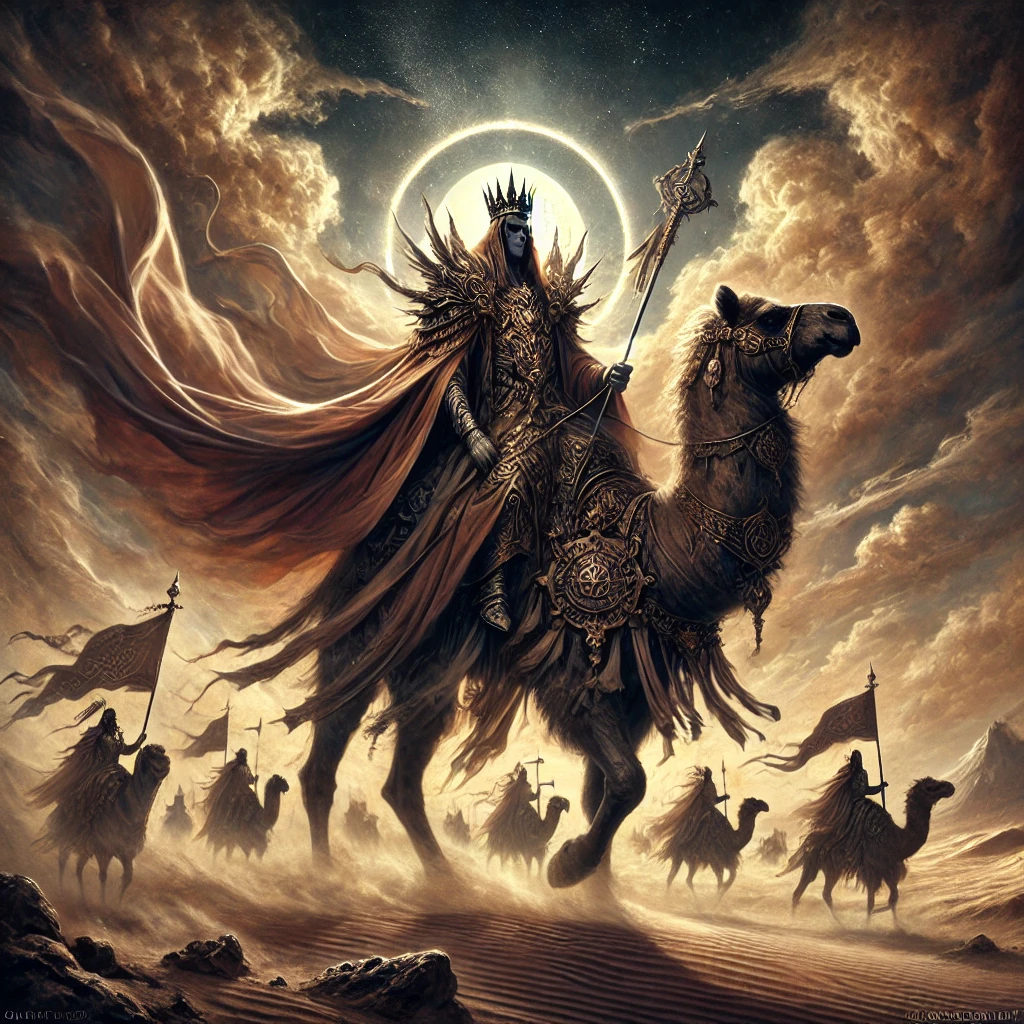
The Ninth Spirit in this Order is Paimon, a Great King, and very obedient unto Lucifer. He appeareth in the form of a Man sitting upon a Dromedary with a Crown most glorious upon his head. There goeth before him also an Host of Spirits, like Men with Trumpets and well sounding Cymbals, and all other sorts of Musical Instruments. He hath a great Voice, and roareth at his first coming, and his speech is such that the Magician cannot well understand unless he can compel him. This Spirit can teach all Arts and Sciences, and other secret things. He can discover unto thee what the Earth is, and what holdeth it up in the Waters; and what Mind is, and where it is; or any other thing thou mayest desire to know. He giveth Dignity, and confirmeth the same. He bindeth or maketh any man subject unto the Magician if he so desire it. He giveth good Familiars, and such as can teach all Arts. He is to be observed towards the West. He is of the Order of Dominations.13 He hath under him 200 Legions of Spirits, and part of them are of the Order of Angels, and the other part of Potentates. Now if thou callest this Spirit Paimon alone, thou must make him some offering; and there will attend him two Kings called Labal and Abali, and also other Spirits who be of the Order of Potentates in his Host, and 25 Legions. And those Spirits which be subject unto them are not always with them unless the Magician do compel them. His Character is this which must be worn as a Lamen before thee, etc
-The Lesser Key of Solomon
Names: Paimon, but you may also find his name spelled as Paymon
Rank: King
Legions: 200
Day or Night: Strongest during the day, but don’t let that stop you from contacting him at night
Direction: West, North-West
Zodiac: Taurus, Gemini
Element: Water, Air
Tarot: 6 of Coins, 10 of Swords
Candle/Altar Decor Color: Yellow, Red, White, Black, Dark Blue, Green
Planet: The Sun / the Black Sun (Primary), Jupiter
Attributions: Frankincense, Coltsfoot, Bindweed, Gum Arabic, Balm of Gilead, Gold. Mercury is also attributed to him, however, this is not reasonable for the modern mage to use.
1. The History and Origin of King Paimon
King Paimon’s origins are a tapestry of complex and ancient roots, interwoven through various cultures and occult traditions. Found prominently in The Lesser Key of Solomon or Ars Goetia, he is listed as one of the principal Kings of Hell, commanding legions with the bearing of a royal and dignified figure. His title of “King” is not honorary; he is one of the nine demonic kings in Goetic tradition, ruling over approximately 200 legions of spirits, both benign and maleficent in nature. If you dare to evoke him, remember to use his title.
Some scholars draw connections between Paimon and pre-Islamic deities or jinn spirits from the Middle Eastern lore, considering his authority and traditional descriptions. Ancient Persian and Arabian magicians would have recognised him as a figure that transcends mere demonic classification—a wise entity, embodying both spiritual and material mastery. Such associations reflect a being of vast authority, intellectual might, and mystical potency, qualities that remain essential to understanding him.
2. The Appearance and Symbolism of King Paimon
When King Paimon manifests (either in the astral or through evocation), he often does so with tremendous pageantry. He is traditionally described as riding upon a dromedary (a single-humped camel), attended by an entourage of spirits and trumpeting fanfare. This spectacle is not mere show; it signifies his royal stature and serves as a reminder of his absolute command. His very presence demands attention and respect, and he often requires his name to be spoken with reverence.
King Paimon’s voice, when heard, is said to be loud, commanding, and penetrating—a voice that seems to resonate beyond the hearing of mere ears, vibrating within one’s very soul. He appears adorned with a golden crown, embodying both wisdom and authority, and his bearing is one of serene but unbreakable control. When you engage with him, expect nothing less than the essence of a sovereign. This vision is vital; for many practitioners, his image strengthens the connection, enhancing the fidelity of their evocation. When he engages with you, he expects nothing less than the essence of a sovereign.
3. Domains and Abilities of King Paimon
King Paimon’s expertise is vast. His knowledge encompasses sciences, arts, philosophy, and hidden wisdom, making him a spirit sought by magicians who seek true enlightenment and knowledge. His influence reaches deep into the following areas:
- Sciences and Hidden Knowledge: King Paimon is well-versed in all scientific disciplines and is an excellent ally for those seeking academic or intellectual mastery. His insights extend to occult philosophy, ancient sciences, and advanced theories that might only be understood in altered states of consciousness.
- Influence and Persuasion: As a spirit of command, King Paimon teaches the art of influence, diplomacy, and rhetoric. Those in politics, business, or leadership roles may find his guidance particularly beneficial, as he imparts not only strategies for persuasion but also an aura of authority that compels respect.
- Alchemy and Transformation: King Paimon’s knowledge also veers into the alchemical, both in terms of internal transformation and the art of turning base materials into spiritual gold. He aligns with those who seek deep, personal metamorphosis, helping them to refine their rough edges into something resilient and radiant.
- Spirit Communication: King Paimon is well connected within the spirit realms, not only commanding legions but also acting as an intermediary between realms. His connections make him an ideal figure for those looking to explore other spiritual dimensions, for he has authority over both demonic and angelic spirits in his 200 legions. With his guidance, one may learn to navigate these realms with a certain diplomatic protection that few others can provide.
4. The Sigil and Enn of King Paimon
Like many Goetic spirits, King Paimon’s presence can be summoned by his sigil, a distinct symbol that resonates with his unique energetic signature. Meditate on his sigil before evocation, allowing it to fill your mind’s eye and establish a psychic link to him. To enhance this connection, King Paimon’s enn, or chanted calling, serves to resonate his frequency within the operator:
- Sigil:
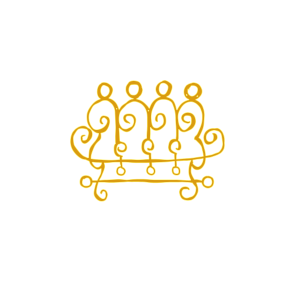
- Some people will draw it with a circle around it at the name written around the edges, and some people will draw those inner P shapes as only the circles; all options are valid, but I choose to not place the entity within a circle.
- Enn: “Linan tasa jedan Paimon”
- Pronounced as lee-NAHN tah-sah yay-DAHN PIE-mohn
- IPA: /liˈnɑːn ˈtɑːsɑː jeɪˈdɑːn ˈpaɪmən/
Chanting this enn during ritual helps attune your energy to his, opening a psychic pathway. Repeat it until you feel his presence gather, often signified by a change in temperature, a shifting density in the air, or a profound inner knowing.
5. Preparing for an Evocation of King Paimon
To summon King Paimon, one must be both prepared and precise. He does not respond to the casual magician or those with capricious intentions. A successful evocation depends on one’s focus, respect, and clarity of purpose. Begin with a thorough cleansing of your ritual space, ridding it of any lingering energies. This prepares a “clean slate” for King Paimon’s arrival.
- Ritual Tools: King Paimon appreciates ceremonial detail—candles of yellow or gold and rich blue, frankincense incense, and offerings of gold or fine wine, all symbolising his regal energy. Of course, in our modern era, we don’t all have gold hanging around for the offering. It does not need to be a gold bar. King Paimon will also accept a ceremonial golden token such as costume jewellery, plated jewellery, or even an object gold in color. I use a 3D printed gold bar and a gold plated ashtray to hold offerings to King Paimon.
- Arrange these items in a pattern that resonates with you or follows traditional Goetic placements (often a circle with his sigil at the center).
- Mental Preparation: Be very clear in your intentions. Write them out if necessary. Do not approach him with trivial questions; he is a being of depth and wisdom, and he responds best to those seeking genuine growth, knowledge, or mastery. You are wasting the time of a king with your questions about love when he can teach you what holds up the world in the sky.
6. The Ritual of Evocation
Begin by establishing a sacred circle, ensuring your psychic boundaries are firm. As you chant Paimon’s enn and focus on his sigil, allow yourself to enter a trance. Visualise his approach on the astral plane—see the dust of his entourage and the golden shimmer of his crown. His arrival is a palpable force; when you feel him, acknowledge his presence with respect.
Speak your requests clearly, and do not embellish or attempt to flatter him unnecessarily. He prefers sincerity and directness.
When the dialogue is complete, thank him for his presence and allow him to depart in his own time; abruptly ending the ritual may be interpreted as discourtesy. Extinguish the candles and close the ritual with a grounding exercise.
7. Working with King Paimon: Benefits and Warnings
For those who develop a genuine relationship with him, King Paimon can be a profound ally. His insights can offer clarity on matters most mundane minds would not fathom, and his guidance can turn chaos into order. Many practitioners report an increased aura of personal authority after consistent work with him, as well as a notable sharpening of intellect and rhetorical skill.
However, he is not a spirit to be taken lightly. Paimon respects strength, intelligence, and command; if you approach him without these, he may dismiss you, or worse, expose your weaknesses. Those who seek him out for mere spectacle, power, or control over others often find themselves frustrated or thwarted, for Paimon values wisdom over arrogance. If you are willing to learn and to humble yourself before his knowledge, he may indeed reveal profound secrets.
8. The Pathworking to Meet King Paimon
For a more gradual approach, consider a pathworking—entering the realm of King Paimon through a structured series of visualisations. Let us begin:
You stand before a towering desert of golden sand, stretching endlessly into the distance.
The air is thick, shimmering with an unnatural, electric energy.
Far on the horizon, you see a figure on a dromedary, flanked by banners and heralds blowing horns.
As he approaches, the sand swirls in vortexes around you; the air grows heavy.
He halts before you, his figure imposing, his eyes blazing.
He beckons you forward with a single gesture, a command as clear as any word. You step forward, feeling his gaze dissect your very essence.
Around you, his retinue stands silent, watching.
Only when he is satisfied with your presence does he speak. His words ring like thunder, filling your mind with insight or judgment, depending on your worth.
This journey, whether real or meditative, brings you into the presence of Paimon in a way that will prepare your spirit for his actual evocation. It is a deep, personal experience, helping you establish a respectful and genuine connection with him.
9. King Paimon’s Role in Modern Magick
In the 21st century, Paimon’s influence remains as relevant as ever. As an entity who bridges the esoteric and the practical, he aligns well with those who seek both intellectual prowess and spiritual mastery. In this era of rapid knowledge and technological advancement, Paimon’s role is clear: he is an initiator of insight, a purveyor of truths that can elevate the mind and the spirit alike.
Many practitioners find his energy conducive to intellectual and personal breakthroughs, whether in academic research, creative pursuits, or spiritual enlightenment. For the mage who desires both knowledge and transformation, King Paimon is a guiding force—a king who sits at the intersection of all wisdom, waiting for those brave enough to step into his court.
I have of course evoked King Paimon and it took some time until summoning King Paimon became less of a daring conjuration and more of a collaboration forged through time and understanding. I remember my first evocation of him: the sigil marked carefully in gold ink, frankincense clouds wreathing the air, and a tangible sense of anticipation.
The moment he arrived, it was as if my reality shifted sideways. The air became dense, almost syrupy, and the faintest sound of trumpets echoed in my mind. He didn’t speak at first; rather, his gaze seemed to pierce through every layer of my consciousness. Imagine being observed by a being who could dissect each element of your psyche, see the flaws you hide even from yourself.
Initially, I approached with my formal requests, notes in hand and all. But it became immediately clear that he was disinterested in mere rote ceremony. He assessed me, gauging if I was there for wisdom, or for ego. And let me tell you, if ego is your intent with Paimon, he’ll reveal the hollowness of your aims in ways that can be…uncomfortable.
Once I understood his standards, my approach shifted to one of respect and genuine curiosity. I asked him about the nature of knowledge, of persuasion, of the kind of power that transforms rather than merely controls. He answered not in direct phrases but in waves of insight—concepts that unfurled in my mind like ancient tapestries.
One of his most memorable teachings? A reminder that true authority does not beg or demand; it radiates from within, an unshakable force that others cannot help but recognise.
To command others, you must first command yourself with absolute clarity.
Since that first encounter, I approach Paimon more as a guide than a “spirit of conquest.” Now, each evocation is less about summoning a king to my space and more about venturing into his—an audience granted, rather than demanded.
King Paimon is, in every sense, a King—a regal, intelligent, and powerful entity who embodies the wisdom of the ages and the authority of command. Working with him is no small feat and requires maturity, focus, and an unshakable intent. Yet for those who dare to engage with him, the rewards are profound: knowledge beyond knowledge, a deeper command of self, and a transformation that aligns your path with his royal insight.
In the end, to summon King Paimon is to summon the sovereignty within yourself. Through his guidance, one may learn not only to command others but to command one’s own spirit, which is, indeed, the highest art of all.
Leave a Reply